I was asked to delineate, order and prioritize every training topic for the Husqvarna support line. The curriculum designers who'd build it were in Manila and had never worked with engines, outdoor power equipment or American yard culture. I gave them a map of the field, and a teaching order to go with it. The curricula they built from it had to train agents in two weeks instead of four.
MY ROLE
Subject-matter expert and content architect
AUDIENCE
Curriculum designers, Manila
FORMAT
Three-page hierarchy + verbal teaching order
TIMELINE
Built Mar 2020 · Sequence Documented Nov 2026
01 / PROBLEM
The Gap Wasn't Vocabulary
In Manila, landscaping services are cheap enough that doing your own yard work seems irrational. The designers had no reason to know why an American owns a chainsaw, a zero-turn mower or a snow thrower, or why one would call the manufacturer about it.
Without that, a list of products is just a list. They couldn't judge which topics mattered, why customers called or what those customers already knew. The deliverable had to be a map of the field, not a curriculum: enough structure for them to build one.
02 / STEP ZERO
Teach the Customer Before the Product
Before a single product, I walked the designers through who calls, in two layers: why Americans care about their yards at all, then which of them call Husqvarna.
PrideAmerican yard culture comes from pride. Homeowners buy their own equipment and do their own yard work, and a kept yard says something about the household.
Keeping up with the JonesesNeighbors compare yards. A visible standard on the street drives what people buy and how urgently they need it working.
HOAsMany neighborhoods have homeowners associations that set and enforce yard standards. For those callers, a broken machine is a compliance problem, not just an inconvenience.
Homeowner vs. professionalHomeowners and professional landscapers are different callers with different knowledge and different stakes. Agents need to know which one is on the line.
The Husqvarna customerProfessional-grade equipment at premium prices. Customers who can afford it either own acreage, which calls for a riding or zero-turn mower, or pay for automation with a robotic Automower.
No push mower, on purposePush mower calls were remarkably rare; that customer mostly buys another brand. The map reflects who actually called, not yard equipment in general.
03 / THE ARTIFACT
Product and Processes, in Three Pages
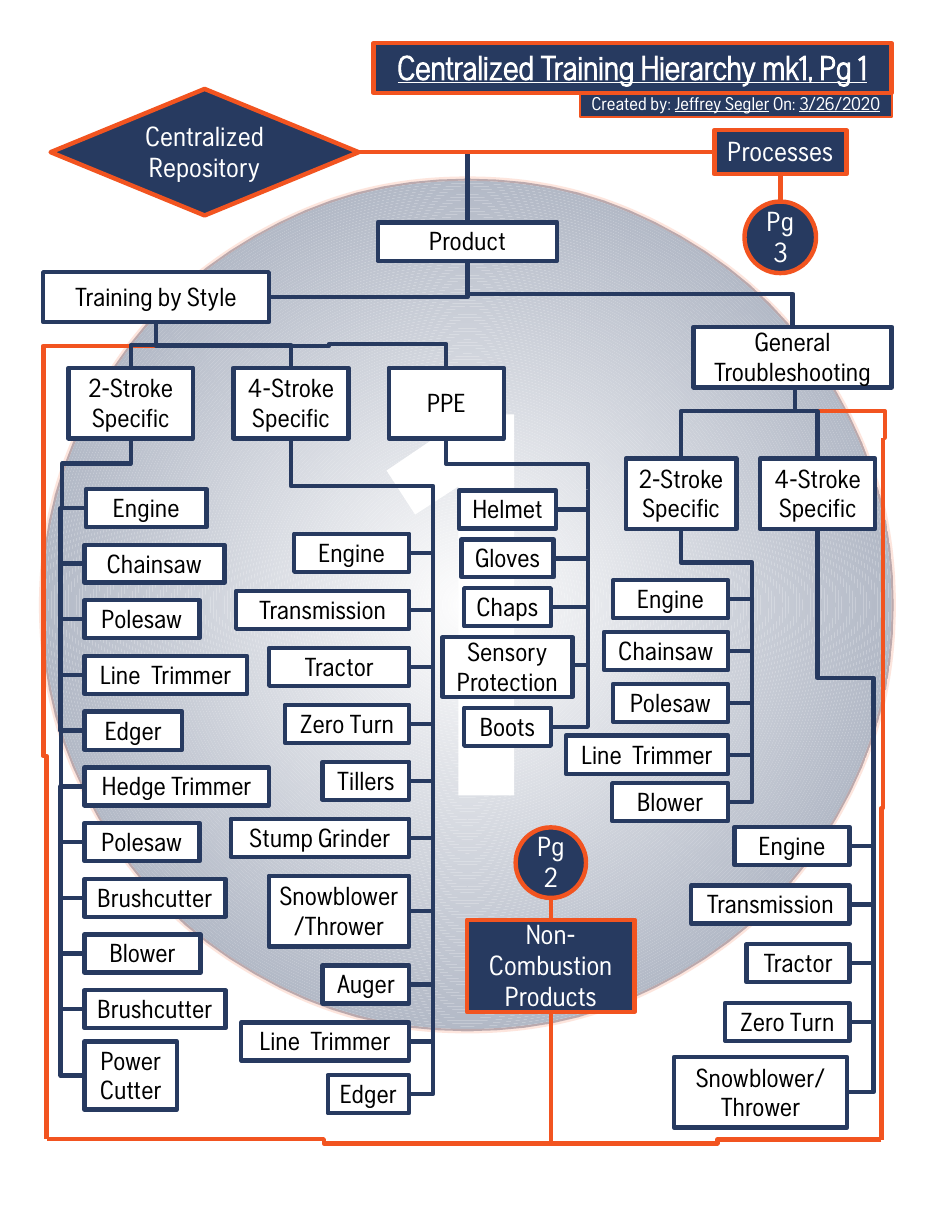
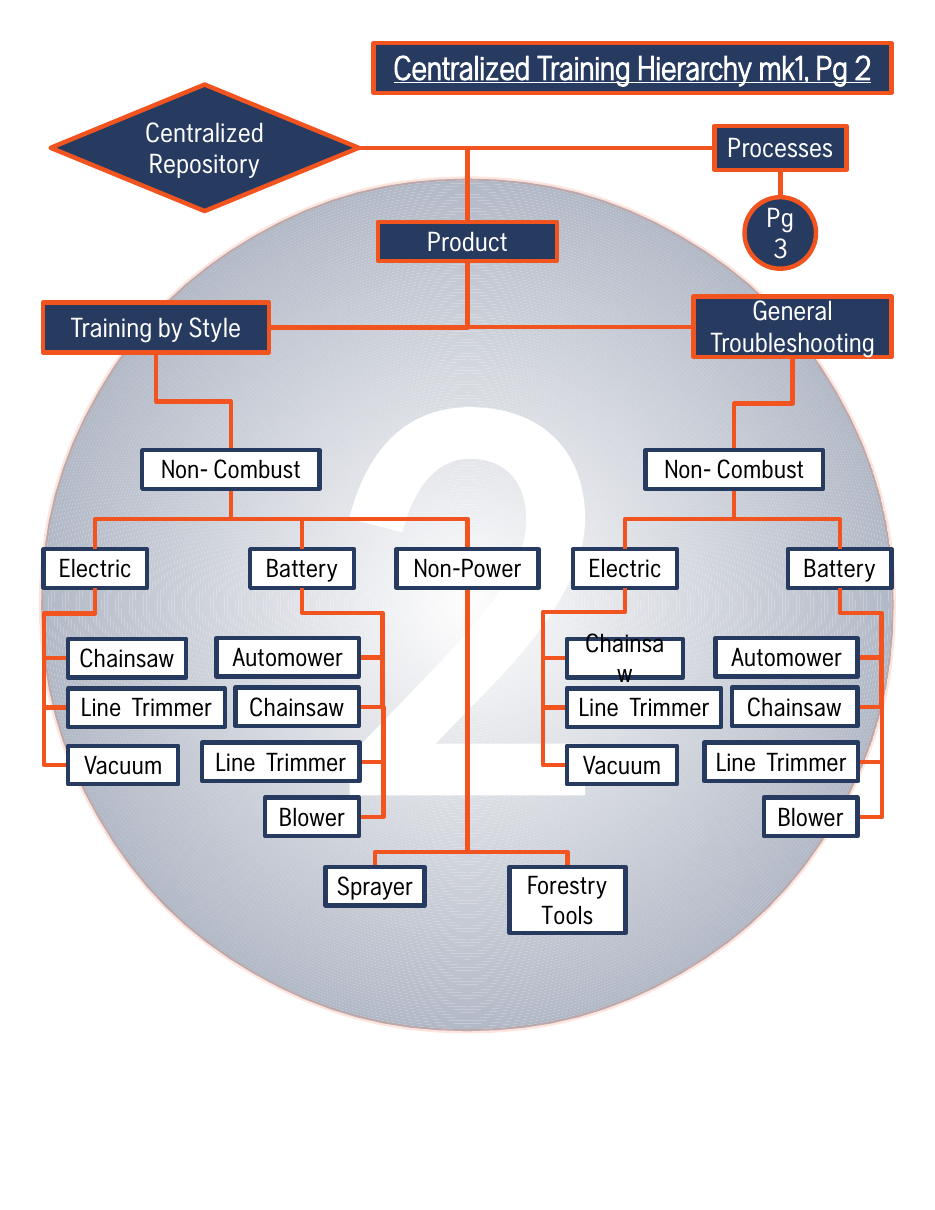
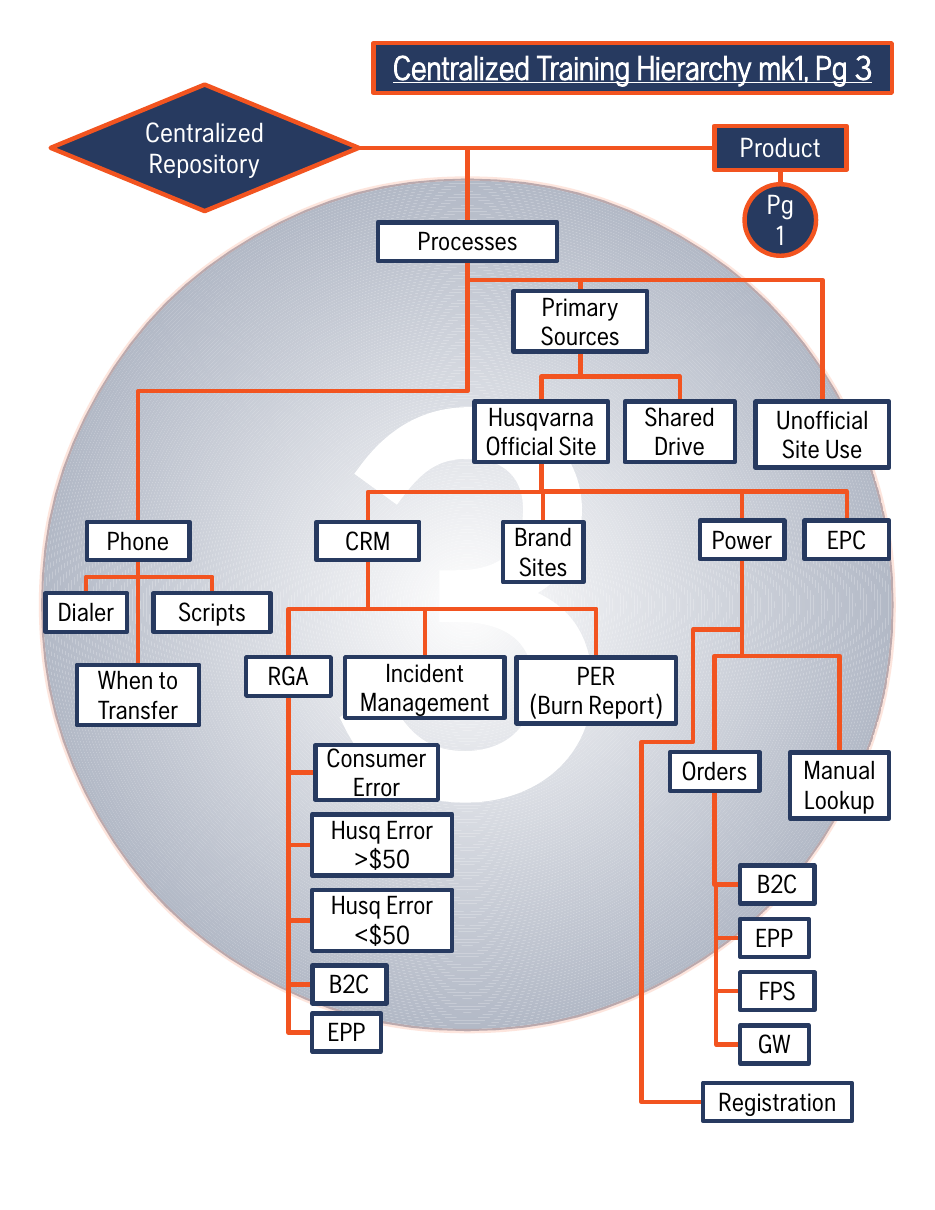
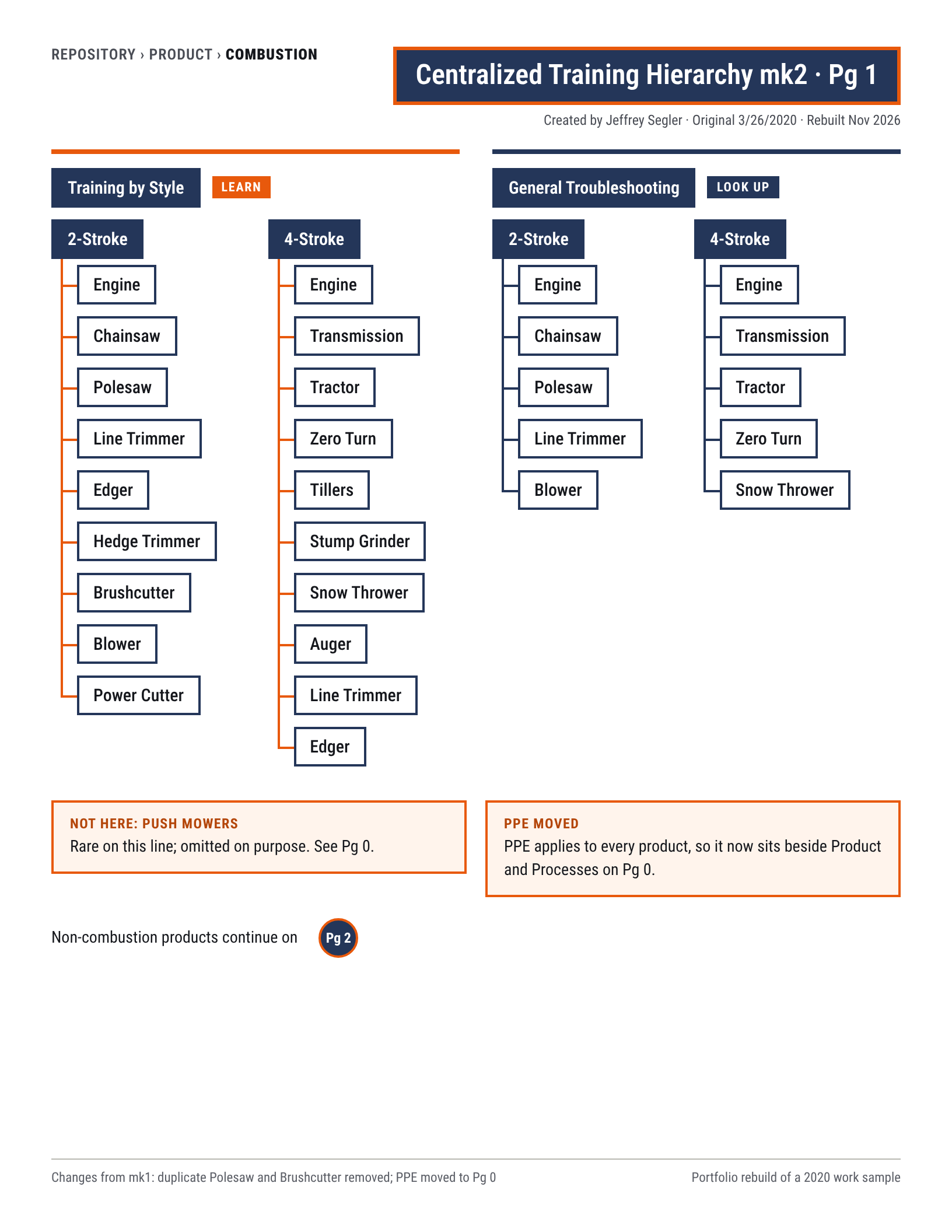
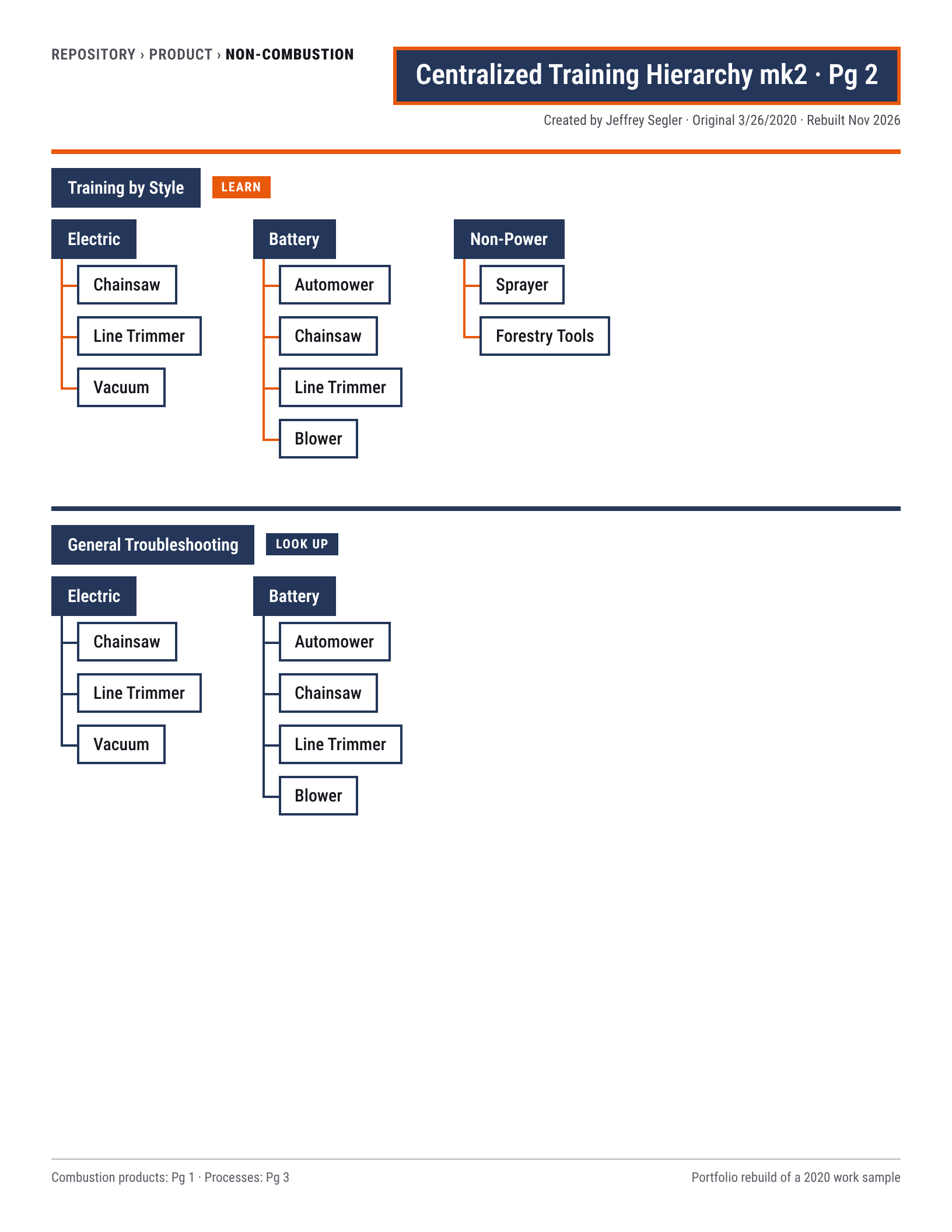
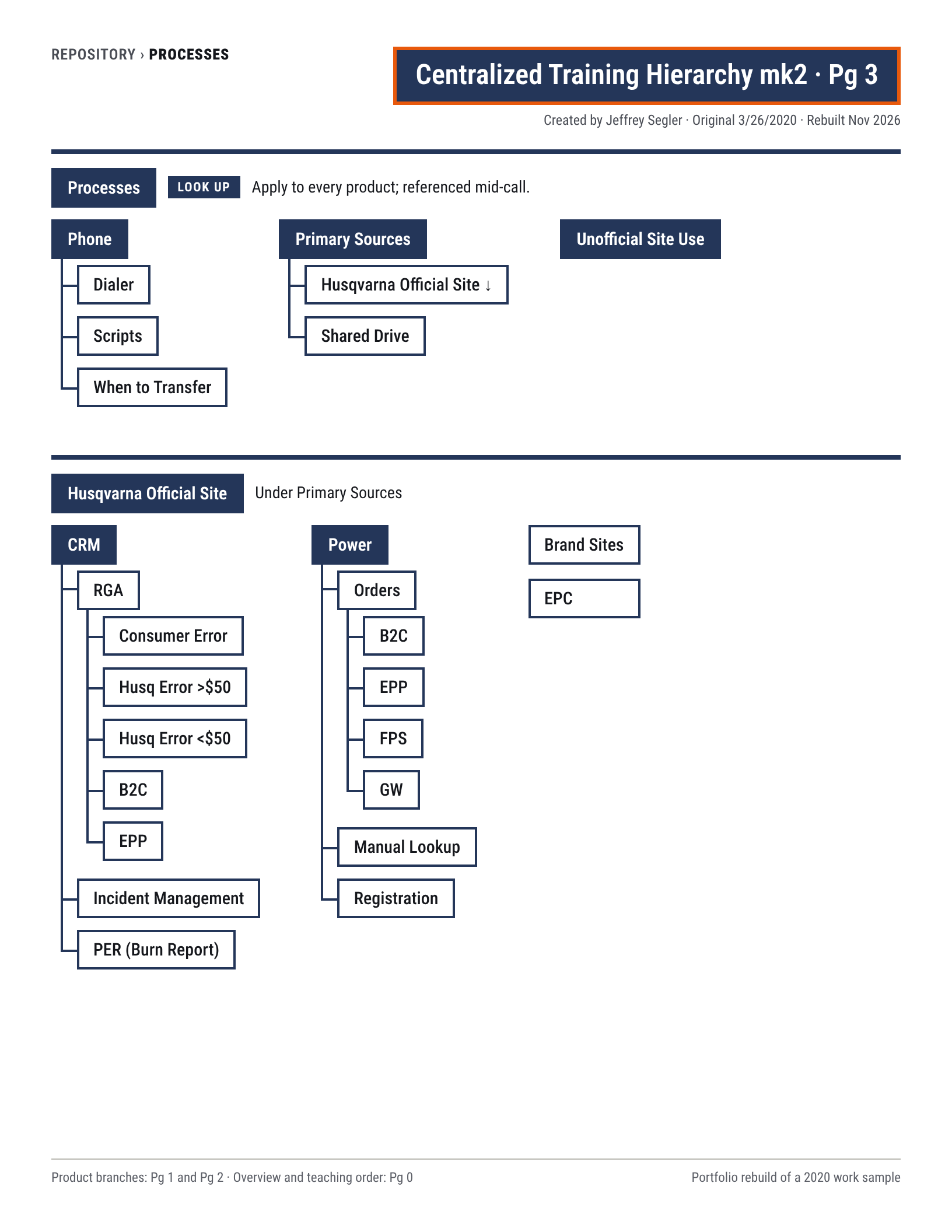
A centralized repository splits into Product and Processes. Combustion products sort by 2-stroke and 4-stroke, non-combustion by electric, battery and non-power. Every product branch appears twice: once under Training by Style, once under General Troubleshooting. These are the original 2020 pages, unedited. The 2026 rebuild is in section 07.
Structural document containing no proprietary content.
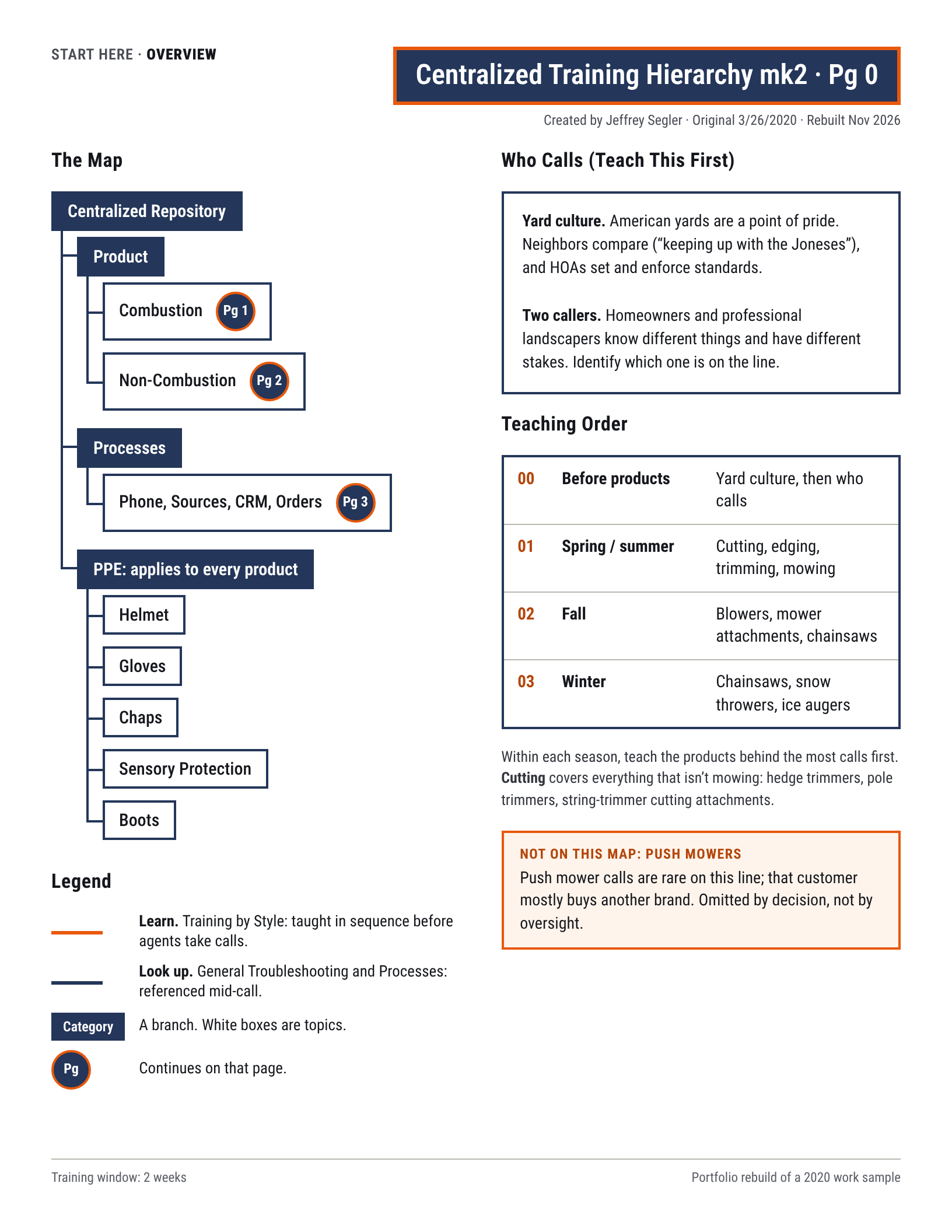
I gave the order verbally in 2020; this is the first time it's been written down. Season extends the cultural frame, because it answers why a customer is calling now. Within each season, the products behind the most calls come first.
00Before any productAmerican yard culture, then the Husqvarna customer
01Spring and summerCutting, edging, trimming and mowing
02FallBlowers, mower attachments and chainsaws
03WinterChainsaws, snow throwers and ice augers
Cutting is a catch-all for everything that isn't mowing: hedge trimmers, pole trimmers, cutting attachments for string trimmers and the like.
05 / TWO STRUCTURES
Store it one way. Teach it another.
The map is organized by powertrain because that's how failures happen and how agents look things up. The teaching order is organized by season because that's when customers need it. Two jobs, two structures, kept separate on purpose.
The same logic splits the map itself: Training by Style is material to learn, General Troubleshooting is material to look up mid-call, and Processes get their own page because they apply to every product.
06 / RESULTS
Half the Time, and Still in Use
The Manila team built the new-hire curricula from the hierarchy and the teaching order, under a hard constraint: training had to be accomplished in two weeks instead of four. With half the time, the order decided what agents learned first and what they could look up mid-call.
TRAINING WINDOW
2 weeks, down from 4
REACH
Several Husqvarna-owned brands
To my knowledge, those curricula are still in use across several Husqvarna-owned brands. I left before I could measure them myself, so I'm reporting reach, not learning outcomes.
07 / THE REBUILD
Put the Judgment on the Page
The structure held up. Its weakness was that its most important decisions lived only in a conversation. The 2026 rebuild, mk2, puts them on the page.
Wrote the order downA new Page 0 carries the audience frame and the season and call-volume sequence, so they outlive the meeting.
Annotated omissionsThe map now says why there's no push mower, so a reader sees a decision, not a gap.
Added a legendConnector color now means one thing everywhere: orange is material to learn, navy is material to look up.
Removed duplicatesPolesaw and Brushcutter each appeared twice under 2-Stroke Specific.
Moved PPE upIt applies to every product, so it now sits beside Product and Processes instead of beside the powertrain categories.
Structural document containing no proprietary content.